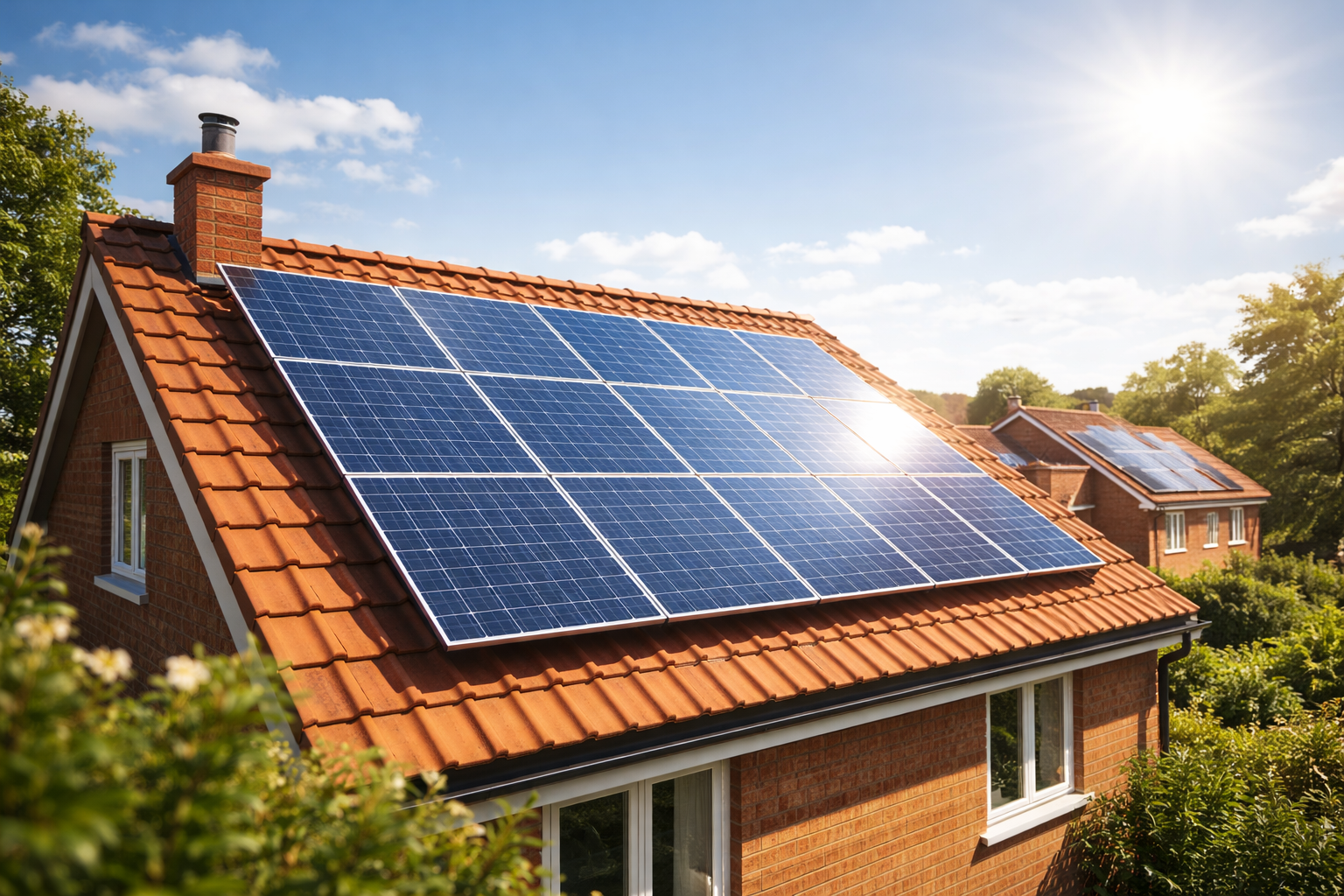
How Solar Panels Work: A Simple UK Guide for Homeowners
Solar panels are one of those technologies that sound complicated until someone explains them clearly. The basic idea is straightforward and once you understand how the pieces fit together you’ll be in a much better position to make decisions about your own home.
This guide covers everything you need to know, no technical background required.
Turning Sunlight Into Electricity
You’ve probably seen solar panels at work already, even if you haven’t thought about it. The small panel on an outdoor security light, a garden ornament, or a calculator works on exactly the same principle as the panels you’d put on your roof: they generate electricity from light.
The process is called the photovoltaic effect. When sunlight hits a solar cell, it knocks electrons loose in a way that creates an electrical current. String enough cells together into a panel, and string enough panels together on your roof, and you have a system capable of generating meaningful electricity for your home.
A common misconception is that solar panels only work in bright sunshine. They don’t. They work on daylight, and will generate electricity even on overcast days just less of it than on a clear summer afternoon. The UK receives enough sunlight to make solar worthwhile across virtually the entire country, which is why installations from Cornwall to Caithness are generating real savings for homeowners.
Modern panels typically convert around 20–23% of the sunlight that hits them into usable electricity. That figure will continue to improve as the technology develops, but it’s already enough to make a meaningful dent in a typical household electricity bill.
Making That Electricity Usable: The Inverter
There’s a catch. The electricity your panels produce isn’t immediately usable in your home.
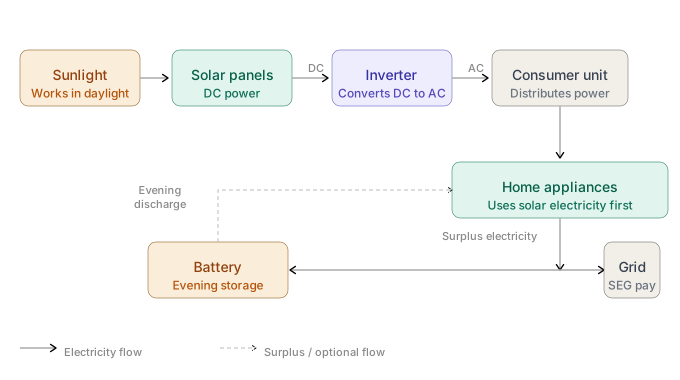
Solar panels generate DC electricity (direct current), but your home — like all UK homes — runs on AC electricity (alternating current). To bridge that gap, every solar installation includes an inverter, whose job is to convert DC into AC so your home can use it.
Here is how a complete solar system connects together:
There are three main types of inverter, and the right choice depends on your roof:
String inverters are the most common and most affordable option. All your panels connect to a single central unit. They work well on simple, unshaded roofs where all panels face the same direction. The one limitation worth knowing: if one panel in the string is shaded or underperforming, it can drag down the output of the others connected to it.
Microinverters sit behind each individual panel, converting electricity at the point of generation rather than in one central unit. Because each panel works independently, shading on one doesn’t affect the rest. They’re more expensive and are installed on the roof alongside each panel, which makes maintenance more involved — but for complex roofs, shaded roofs, or roofs with panels facing different directions, the extra cost often makes sense.
Power optimisers are a middle ground. They attach to each panel and improve its performance individually, but they still feed into a central inverter. They handle shading better than a standard string inverter while being less expensive than a full microinverter setup.
As a general rule: if your roof is straightforward and mostly unshaded, a string inverter is the sensible choice. If your roof has shading from chimneys, trees, or neighbouring buildings, or if panels face different directions, microinverters or optimisers could be worth the additional investment.
What Happens to Electricity You Don’t Use?
During the middle of a sunny day, your panels may produce more electricity than your home is using at that moment. That surplus has to go somewhere.
The two main options are exporting it to the grid or storing it in a battery.
Exporting to the grid is handled automatically. Under the UK’s Smart Export Guarantee (SEG), energy suppliers are required to pay you for the electricity you export. Rates vary by supplier and tariff - typically somewhere between 5p and 20p per unit - and you’ll need to sign up to a SEG tariff to receive payments. They don’t happen automatically.
The economics here are worth understanding. Every unit of electricity your panels generate and your home uses directly saves you around 24-25p (the current grid rate). Every unit you export earns you perhaps 10-15p from a typical SEG tariff. The implication is clear: using your solar electricity yourself is worth roughly twice as much as exporting it. Running the dishwasher, washing machine, or EV charger during the day when the sun is shining makes a real difference to your savings.
Illustrative typical summer day, 4kW south-facing system, average UK household. Actual figures vary by season, location, and usage habits.
Battery storage takes this logic further. A battery stores surplus generation during the day so you can use it in the evening and overnight, rather than exporting it at a lower rate and buying it back later at a higher one. It adds to the upfront cost of your system but significantly increases the proportion of your own electricity you actually consume.
If neither exporting or storing any excess electricity is an option then the production can simply be curtailed at the source i.e. the inverter throttles the flow of electricity.
Shading: Worth Taking Seriously
Shading is one of the most important factors in how well a solar system performs and one of the most commonly underestimated.
Even a small shadow from a chimney, a vent pipe, or a nearby tree can reduce the output of affected panels noticeably. With a string inverter, that reduction can spread to other panels in the same string. With microinverters or optimisers, the impact stays contained to the shaded panel.
If you’re getting quotes for a solar installation, ask each installer how they’ve assessed the shading on your roof and what they’re recommending as a result. A good installer will use shading analysis tools rather than just eyeballing it. The answer will influence both the system design and which type of inverter makes sense for your home.
How Long Do Solar Panels Last?
A long time and they degrade very slowly.
Most solar panels lose around 0.3–0.5% of their performance per year. After 25 years, a well-maintained system is typically still producing over 80% of its original output. Many systems continue performing reliably well beyond that. It’s not unusual for panels installed in the 1990s to still be generating electricity today.
The component most likely to need replacing before the panels themselves is the inverter, which typically has a lifespan of 10–15 years. Budget for an inverter replacement at some point during your system’s life; it’s a routine cost, not a surprise.
Because there are no moving parts, day-to-day maintenance is minimal. Panels are self-cleaning in most UK conditions thanks to rain, though if your roof is in a particularly dusty location or has a very low pitch, an occasional clean can help maintain output.
What This Means for Your Electricity Bills
Put simply, a solar system reduces how much electricity you need to buy from the grid. The more you use during daylight hours, and the more storage you have to shift that generation into the evenings, the bigger the reduction.
A typical 4kW system on a south-facing roof in the UK generates around 3,400–3,800 kWh of electricity per year which is roughly equivalent to a significant proportion of what a typical three-bedroom home uses annually. Whether that translates into large bill savings or modest ones depends on when you use electricity, what tariff you’re on, and whether you have a battery.
Estimated annual output for a 4kW south-facing system at 35° pitch. Source: PVGIS (European Commission Joint Research Centre). Figures rounded to nearest 50 kWh.
The key variables:
- Roof direction and pitch - south-facing roofs at around 30–35 degrees get the most from their panels, but east/west orientations still generate well and can give you a more even spread of generation across the day
- Shading - as discussed above, this matters more than many people realise
- Your usage patterns - households with higher daytime electricity use (home workers, families with young children) tend to benefit more than those who are out all day
- Battery storage - adds cost but significantly improves how much of your own generation you actually use
The Bigger Picture
A solar system is simpler than it sounds. Sunlight hits the panels, electricity is generated, the inverter makes it usable, your home uses what it needs, and anything left over goes to a battery or the grid.
Once it’s installed, the system runs automatically. There’s no fuel to buy, no combustion, and very little that can go wrong. The panels sit on your roof quietly doing their job for decades.
For most UK homeowners, the question isn’t really whether solar works because it does, and the evidence is well-established. The more useful questions are about sizing the right system for your roof and usage, choosing the right installer, and deciding whether battery storage makes sense for your circumstances.