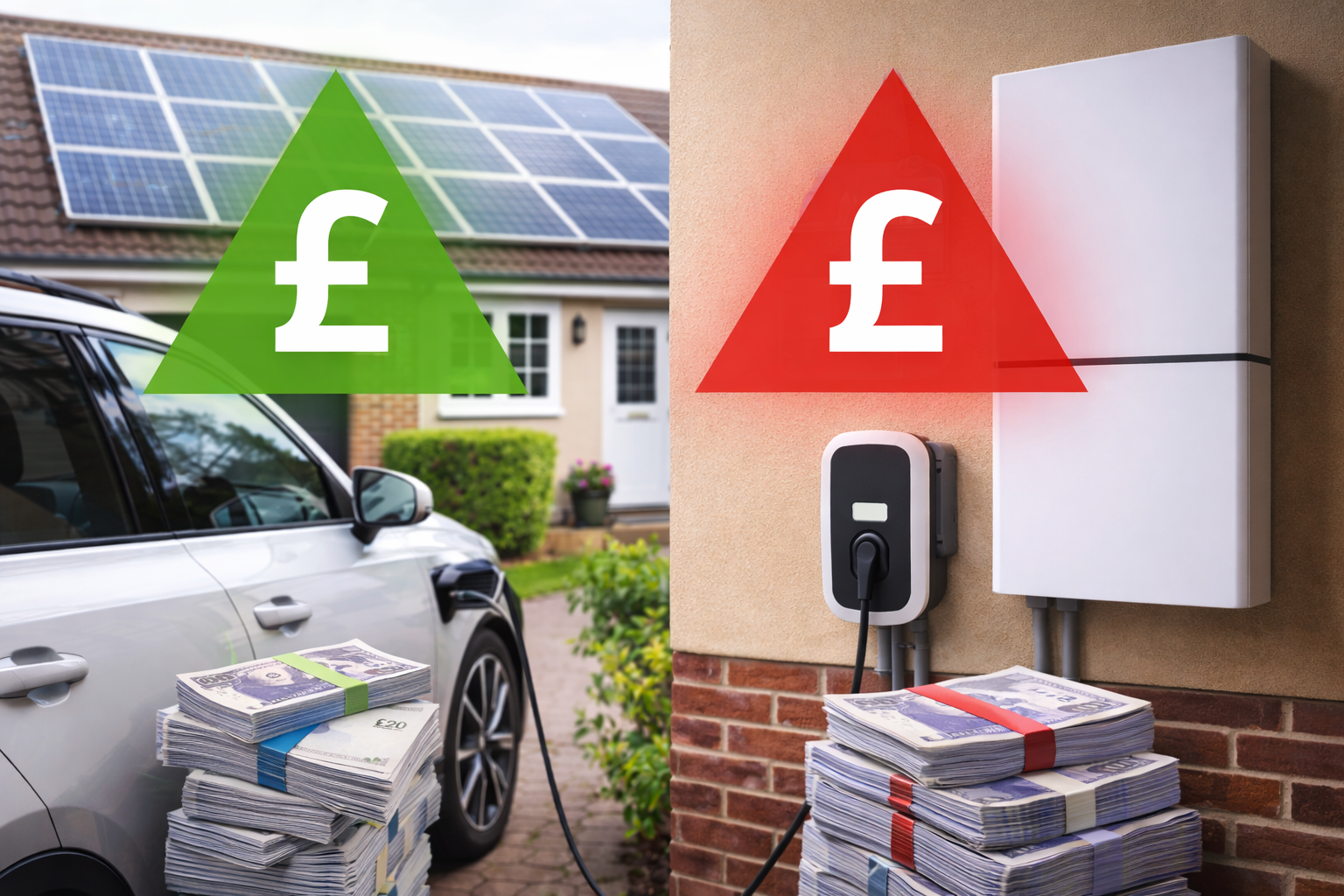
If you’ve looked into home batteries in the UK as a means to reduce your electricity bill and you don’t have an electric vehicle (EV), you may have noticed something odd.
EV owners are often offered cheap overnight electricity through special tariffs from energy suppliers.
Battery owners who could use that same cheap electricity just as effectively are usually excluded from these EV tariffs unless they have an EV to meet the eligibility requirements.
At first glance, that doesn’t make much sense.
- Both can shift demand.
- Both can reduce pressure on the grid.
- Both can make better use of off-peak electricity.
So why are they treated differently?
The obvious explanation (and why it falls short)
A common explanation is that energy suppliers want to avoid arbitrage.
The idea goes like this:
- Buy electricity cheaply overnight
- Use it during the day (or even export it)
- Undermine supplier margins
But this explanation doesn’t really hold up.
Because the moment vehicle-to-home (V2H) or vehicle-to-grid (V2G) becomes widespread:
EVs effectively become large batteries.
And not small ones — EV batteries are often 40–100 kWh, far larger than most home systems.
At that point, EV owners will be able to:
- store cheap electricity
- use it later
- potentially export it
In other words, the same “arbitrage risk” applies — at a much larger scale.
So if arbitrage were the real concern, EV tariffs wouldn’t exist in their current form.
What’s actually going on
The difference isn’t about what’s technically possible.
It’s about how energy suppliers make money.
EVs increase demand. Batteries reduce it.
This is the key distinction.
EVs:
- Increase total electricity consumption by moving drivers away from fossil fuels
- Add new, predictable demand as drivers charge typically when sleeping or according to a regular pattern
- Create more revenue for energy suppliers
Batteries:
- Shift demand away from peak periods
- Reduce reliance on high-cost electricity
- Potentially eliminate the most profitable consumption
To sum it up:
EV tariffs grow the overall market. Battery usage erodes the most valuable part of it.
It’s also about control
There’s another important factor: control and predictability.
EV charging is relatively easy to model:
- It usually happens overnight
- It follows consistent patterns
- It can be influenced through apps or smart chargers
Home batteries are different.
They are:
- fully programmable
- highly flexible
- capable of responding instantly to pricing signals
From a supplier’s perspective:
EV charging is behaviour they can guide. Battery usage is behaviour they can’t easily control without incentives for the owner.
Policy plays a role too
There’s also a clear policy bias.
Governments actively want:
- EV adoption
- reduced transport emissions
So:
- EV tariffs are encouraged
- Infrastructure is supported
Home batteries don’t have the same push.
They are often seen as:
- optional
- an optimisation tool
- something for early adopters
The irony
What the energy companies and government say they want and what they actually do are two different things because home batteries are exactly the kind of technology that could:
- reduce peak demand
- store excess renewable energy
- stabilise the grid
In other words:
They solve the problems the energy system is trying to address and yet they’re not widely supported by tariff structures.
The bigger picture
The current system isn’t designed around optimisation for the home owner or the grid.
It’s designed around growth.
- Encouraging new electricity demand (EVs)
- Managing supply around that demand
- Maintaining stable revenue models
Home batteries don’t fit neatly into that structure because they reduce the need for electricity at the most expensive times.
Why this won’t last
The line between EVs and batteries is already starting to blur.
As vehicle to home (V2H) and vehicle to grid (V2G) become more common:
- EVs will behave like home batteries
- Large-scale storage will sit inside millions of driveways
- Users will expect to optimise how and when they use energy
At that point:
The current tariff structure starts to break down.
Because the system will have to deal with:
- distributed storage
- flexible demand
- real-time optimisation
What this means for homeowners
Right now, battery owners are slightly ahead of the system.
They have the capability to:
- shift demand
- reduce costs
- increase self-sufficiency
But they don’t always have tariff structures that fully support it. That’s why outcomes vary so much.
If you run the numbers, you’ll find that:
The value of a battery depends heavily on access to cheap off-peak electricity and how you use it.
Bottom line
EV owners aren’t being rewarded because they’re more helpful to the grid.
They’re being rewarded because they fit more neatly into how the system currently works.
But that distinction is temporary.
The future of home energy isn’t just about using electricity it’s about managing that usage.
And when that shift happens, batteries won’t be the exception anymore.
They’ll be central to how the system operates.