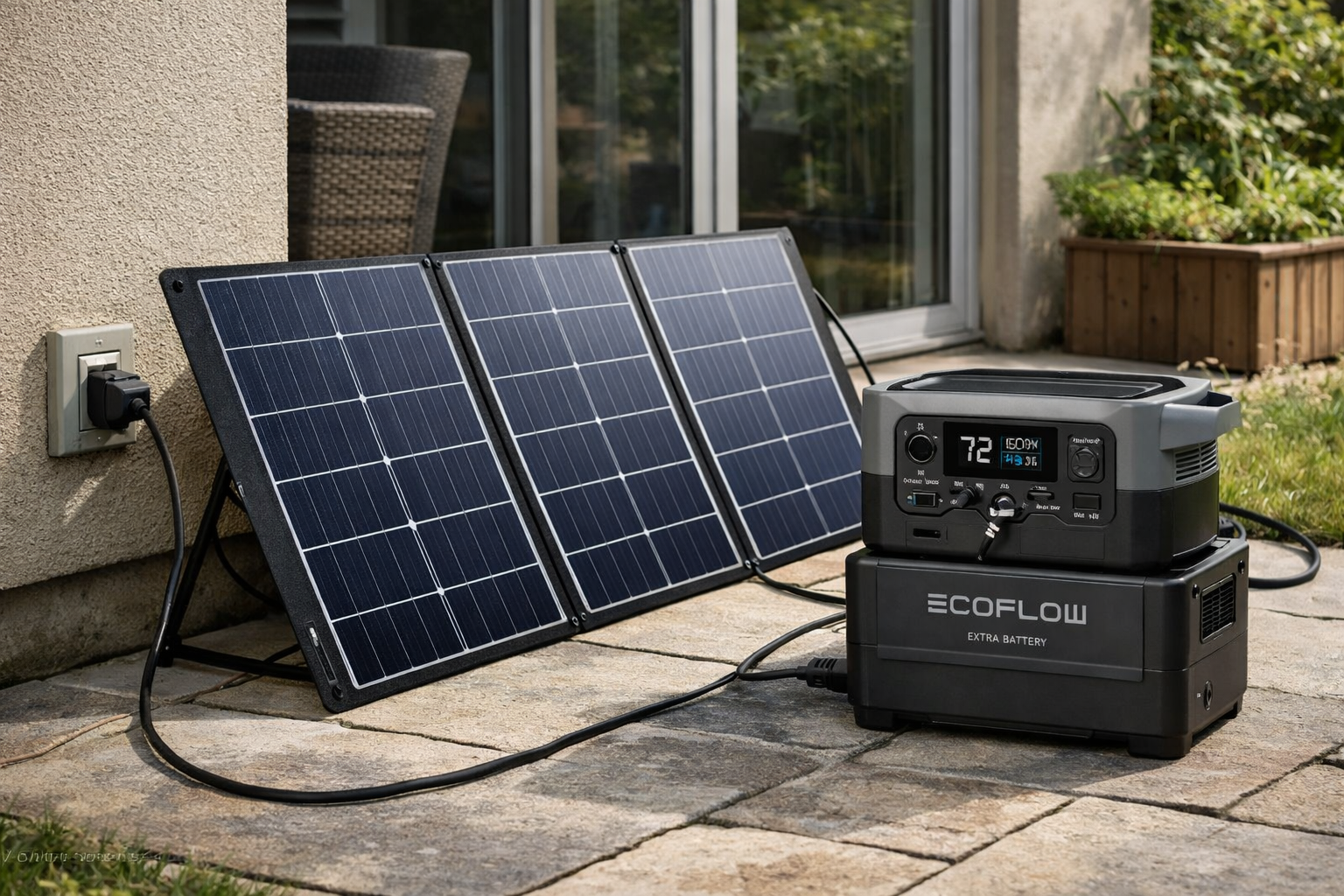
If you’ve been looking into solar for your home, you’ve probably come across a new term: plug-in solar (sometimes called balcony solar).
Until recently, this wasn’t really an option in the UK. But that’s changing fast.
Here’s a clear, jargon-free explanation of what’s been announced, what it means, and whether it’s worth your attention.
What is plug-in solar?
Plug-in solar is exactly what it sounds like:
- A small solar panel system, maybe one or two panels
- Which connect to a microinverter
- That you plug directly into a standard household socket
- Without needing a full rooftop installation
When enough sunshine lands on the panels, they generate DC electricity which is then converted by the microinverter into AC electricity. The microinverter may even include a battery to provide a means of storing electricity for later use. Instead of wiring into your consumer unit, the system feeds power into your home via a standard 3-pin plug. Importantly, plug-in solar systems don’t require a qualified electrician to install them.
The electricity they generate or have stored can then be used by whatever household appliances are running at the time.
These systems are usually mounted on:
- Balconies
- Garden fences
- Sheds or walls
- The ground
Why is this suddenly being talked about?
Because the UK is finally moving to allow it.
For years, plug-in solar has effectively been blocked by electrical regulations and safety concerns. In practice, that meant:
You needed a properly installed, grid-connected solar system.
Recent government announcements (2025–2026) signal a clear shift:
- Plug-in solar systems are being legalised for household use
- Safety standards are being updated to accommodate them
- Retail rollout is expected through major UK stores
In short, what used to be “not allowed” is becoming a mainstream consumer product.
How is this different from normal solar panels?
| Feature | Plug-in solar | Rooftop solar |
|---|---|---|
| Installation | DIY (plug into socket) | Professional install |
| Cost | ~£500–£1,000 | ~£5,000+ |
| Size | Small (≈ up to ~800W) | Large (3–6kW typical) |
| Best for | Flats, renters, small spaces | Houses with suitable roofs |
| Impact | Reduces daytime usage | Can power most of a home |
The key difference is scale.
👉 Plug-in solar is not designed to power your whole home 👉 It’s designed to chip away at your electricity usage
How much could you actually save?
These systems are small and the savings are modest but real.
Typical expectations:
- Output: a few hundred watts during sunny periods
- Annual savings: roughly £70–£150 per year
- Payback: often 2–5 years, depending on usage and cost
The key idea:
Your solar panel powers things like your fridge, router, or standby devices during the day which reduces how much you need to import from the grid.
Who is this actually for?
This is where plug-in solar becomes interesting as it’s specifically aimed at people who can’t easily install traditional solar:
✔ Good fit:
- Flat or apartment owners
- Renters who don’t want a permanent fixture
- Homes without suitable roofs
- People wanting a low-cost entry into solar
✖ Not ideal:
- Homes already planning full rooftop solar although some might like the idea of a completely separate means of generating and storing electricity
- People expecting large bill reductions
Why is the government pushing this?
There are a few reasons behind the policy shift:
1. Energy affordability
Lower upfront cost makes solar accessible to more households.
2. Energy security
More small-scale generation reduces reliance on imported energy.
3. Proven success abroad
Countries like Germany already have over a million installations.
The UK is essentially catching up.
Are there any downsides?
Yes, and it’s important to be realistic.
Limited output
You won’t run your whole home on this although 800W may be enough for everything you would usually leave on throughout the day.
Position matters
Panels on balconies or fences may get less sunlight than rooftops. Clear, unobstructed views of the sun when it’s highest in the sky are typically best. South and west facing panels will provide the most generation in the northern hemisphere.
Regulations still evolving
Standards and limits (likely around ~800W systems) are still being finalised
No export optimisation
You’re mainly offsetting your own usage, not exporting for income
So… is it worth it?
It is worth considering if:
- You can’t install rooftop solar
- You want a cheap, low-risk way to reduce bills
- You like the idea of generating some of your own energy
The bottom line
Plug-in solar is a small but important shift in the UK energy landscape.
- It lowers the barrier to entry into the world of solar power generation
- Opens solar up to renters and flat owners and those who want a less permanent or more portable solution
- Turns solar into a simple, accessible consumer product
- It introduces people to the concept of energy independence
It won’t transform your energy bill overnight, but it does make solar something far more people can actually use.
If you’re just starting your solar journey, think of plug-in solar as a first step, not the final destination.